
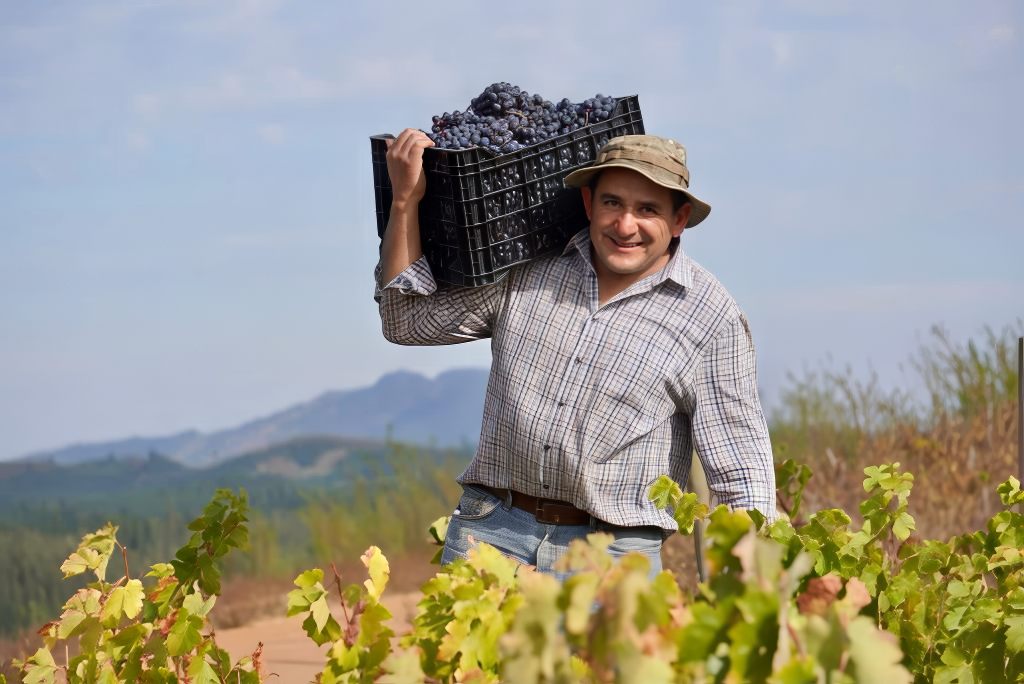
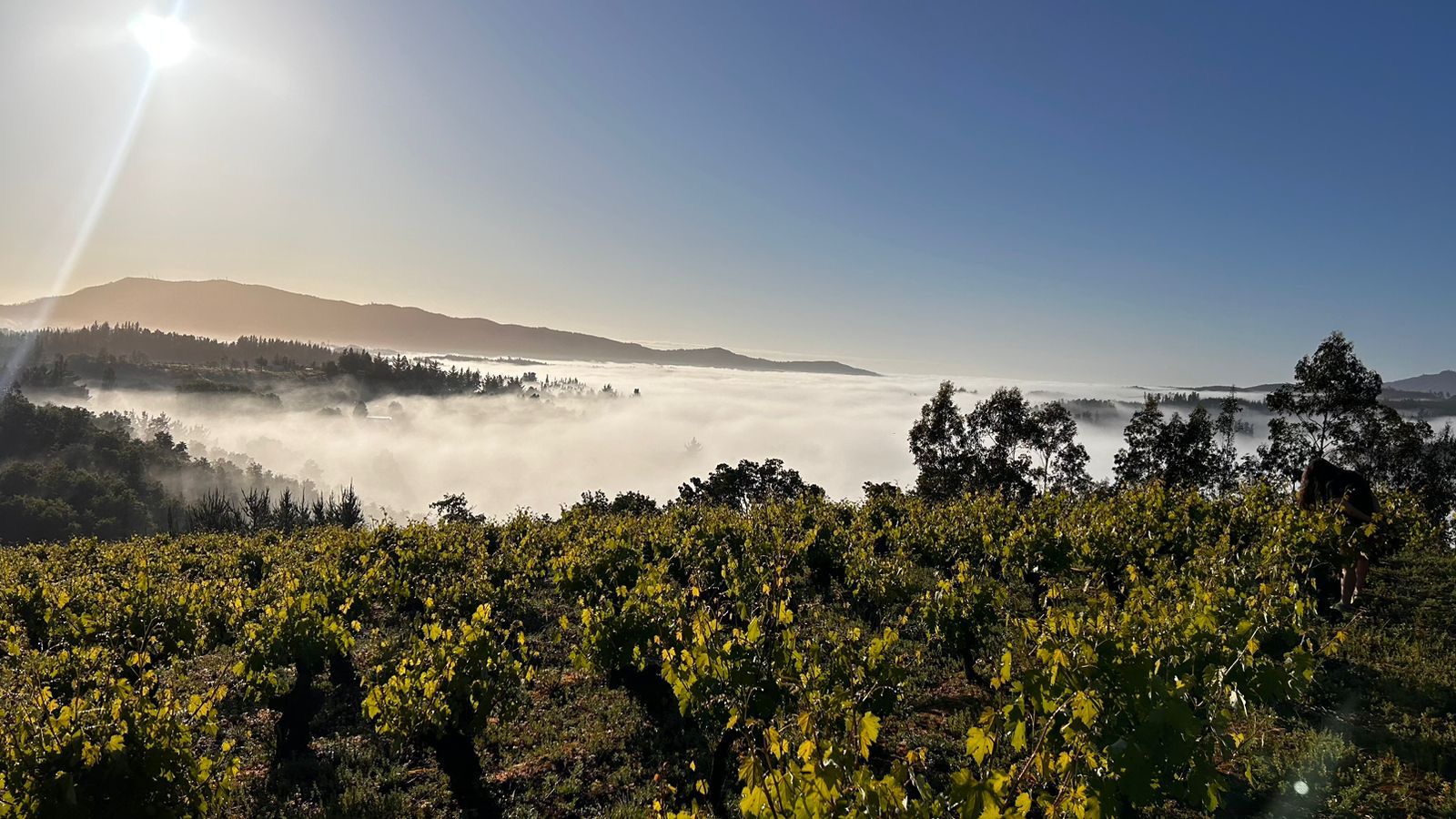
There are valleys that keep stories under the earth, and the Itata is one of them. There, where viticulture was born centuries ago and where several fires have put its memory to the test, Viña Castellón has built a project rooted in the family identity and the dry land landscape.
What began as an act of perseverance on the part of its founder turned into an unexpected discovery: six new strains discovered in the middle of a territory that seemed already completely known, but that continues to show us that it still has secrets to be unveiled.
It was also the joint work with the Universidad Mayor that made it possible to scientifically validate what intuition and experience had anticipated.
This conversation with Víctor Castellón reveals how the Itata continues to be reborn, how its people continue to defend a living heritage, and how a small vineyard can transform the history of Chilean wine.
Don Víctor, let's do a little history. Tell us how Viña Castellón was born and why you decided to consolidate your winemaking project in the Itata Valley.
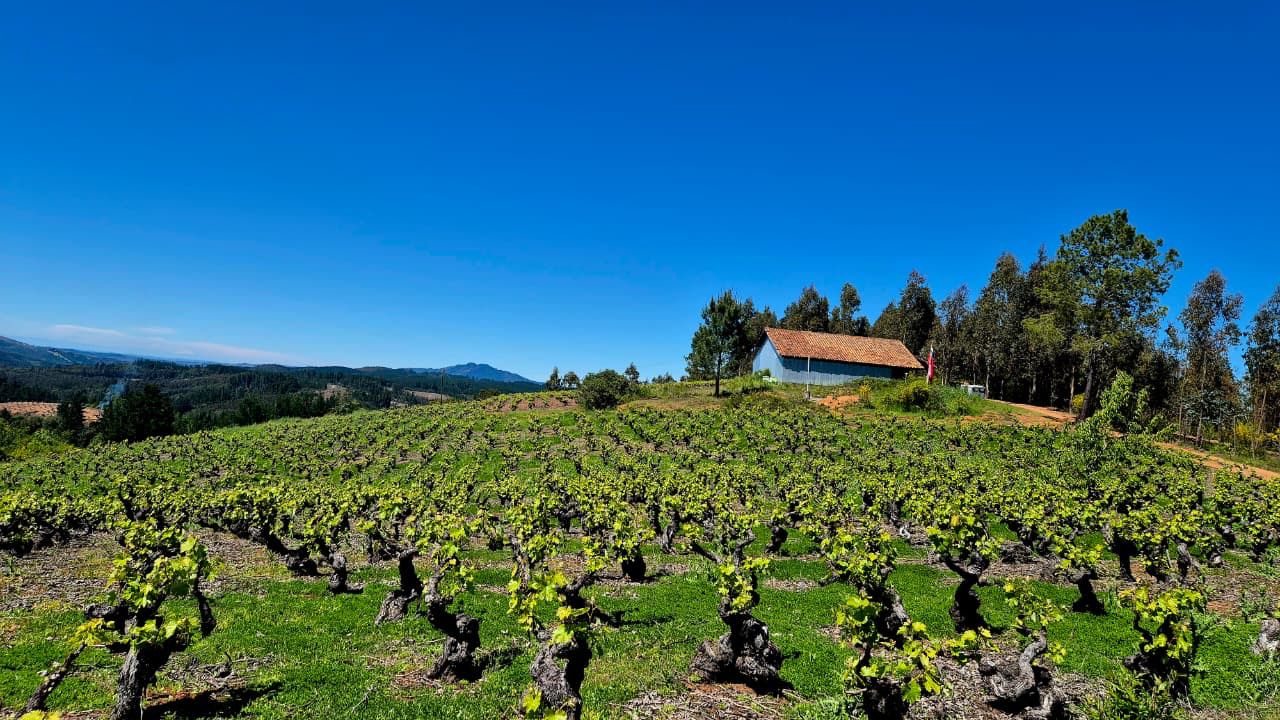
Viña Castellón was born from family memory and identity. During my childhood, the valley was always synonymous with work, tradition and community; I grew up surrounded by old vines, grape harvests and a landscape marked by granite and the coastal breeze.
Over the years, I realised that this area had a unique wine heritage, often invisible compared to other, better-known regions.
Deciding to consolidate the project in the Itata Valley was not a commercial choice, but a conviction: here are the roots of Chilean viticulture, centenary varieties on their own feet and a peasant culture that is still alive. Viña Castellón was created to honour this legacy, to recover ancient techniques, to value our traditional grape varieties and to demonstrate that this humble and deep valley has an extraordinary potential when it is worked with respect, identity and a sense of origin.
What motivated you to continue your winemaking work in Ránquil, especially after the fires of 2017?
I took my first steps in the Fundo El Carmen, a few metres from where the vineyards are today, a place that belongs to the neighbouring commune of Florida. The history of this territory has been marked by great characters and it is thanks to them that we have our republic, and from them I inherited a deep sense of belonging.
That culture of effort, perseverance and resilience is part of my identity. That's why, even after the fires of 2012 or 2017 and all those that have hit the valley before and since, I never thought of abandoning my winemaking work in Ránquil.
Perhaps there is some stubbornness, but above all there is an emotional commitment to a valley that is part of my life story, a place where I have decided to live until the sun stops shining.
The Itata Valley has a culture that rises again and again after every disaster, be it natural or man-made. I simply follow that example and decided to do the same: stay, rebuild and continue working this land.
At that difficult time, did you imagine that years later you would be making such an important discovery for Chilean wine?
In those difficult times, my expectations of achieving the goals I had set for myself never changed. I have always known that any worthwhile path comes with obstacles, and that the journey would never be easy. One of my life philosophies is to transcend: to leave a mark, to prove that if you set your mind to it, you can get there.
That's why I do what I'm passionate about. When you really want something, you can achieve it. As Nicholas Murray Butler said, there are three kinds of people: those who make things happen, those who watch things happen, and those who wonder what happened. I have always tried to be in the first group.
I am very optimistic even in hard times, because I deeply believe that in this treasure called the Itata Valley there is still much to discover and much to do. And today, looking back, I understand that every obstacle helped me to grow, and I crossed the right people who have allowed me to be an actor who contributes to Chilean wine.
What does the Itata Valley represent for you, both as a producer and as a territory that is part of the history of wine in Chile?
For me, the Itata Valley is much more than a place to work: it is my greatest treasure. I consider myself fortunate and deeply grateful to have been born in a territory marked by great military figures in Chile's history, artists, musicians, leaders and community leaders who have left an indelible mark.
Itata is a valley with identity, with culture, with a living memory that crosses generations. And, of course, it is the cradle of the national viticulture, with a history that begins with the arrival of the Spaniards and that has been maintained until today thanks to the efforts of peasant families and small producers.
As a producer, this valley represents an emotional and patrimonial link: it is the origin of everything I do and the territory where I decided to build my life project. As a wine region, Itata is a living testimony of Chile's wine past and, at the same time, a promise for the future.
Production, identity and sustainability
What are the vines discovered, why did you decide to call them Castellón, and how would you describe the style of these new Viña Castellón wines?
The vines discovered correspond to six new varieties identified in our vineyards: Castellón Blanc, Castellón Noir, Chatillon Noir, Rayén de Secano, Philippo and a red variety yet to be presented, which will bear the name Hinrichsen, the latter two in honour of the outstanding professors and researchers, Philippo Pszczólkowski Tomaszewski and Patricio Hinrichsen Ramirez, in recognition of their long trajectory.
These names respond to a strategic commercial vision: to build our own oenological identity, deeply linked to the territory and at the same time allowing us to differentiate our wines in an increasingly competitive market. The surname functions as a seal of origin, of family history and of coherence between the wine, the producer and the Itata terroir.
As for the style of these new wines, they all share a common approach: they authentically express the inland dry conditions, the granitic soil and the traditional practices of the valley.
These are fresh, low-intervention wines, with clear fruit profiles, marked natural acidity and a very characteristic Itata minerality. All in all, they represent a new oenological line that combines innovation, territorial identity and a strong heritage imprint.
How do you feel when you taste a wine made from your own grapes discovered in your own soil?
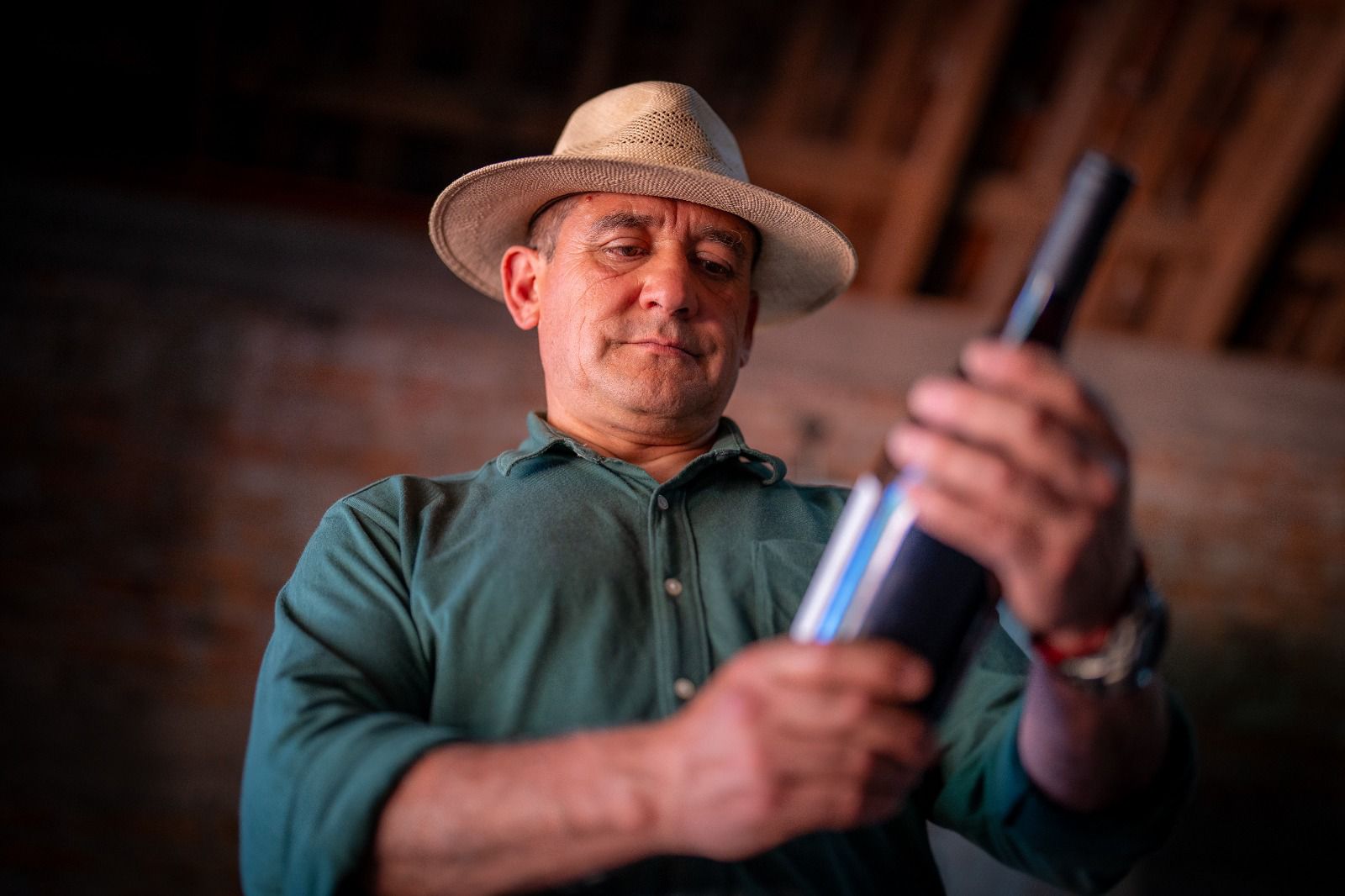
When I taste a wine made with my own grapes and even more, with varieties discovered in my own soil, I feel a deep mixture of pride, gratitude and humility. It is like looking into a mirror of the territory and of my own history.
Each sip reminds me that these plants were born here, in this granitic soil that has seen fires, rains, droughts and also hope. It is not just a wine: it is the concrete manifestation of decades of work, perseverance and a culture that refuses to disappear.
I feel that I am tasting a piece of living memory, something that existed here long before me, but that today it is my turn to guard. And I also feel an enormous commitment: if the earth gives you a discovery like this, the least you can do is to honour it and take care of it for the next generations.
We know that the valley has a strong heritage and family farming component. How do you integrate this local identity in the production of your wines? What do the exponents of the new Castellón vines seek to transmit or how do they relate to the tradition of the Itata?
The Itata Valley is a territory where viticulture is not just a trade: it is a way of life. We integrate this local identity by working with the same pillars that have sustained the families of the valley for centuries: dry farming, manual practices, respect for the granitic soil and a deep bond with the peasant memory. Each wine is born from a living cultural landscape, where old vines, family work and the transmission of knowledge are part of the production process.
In the case of the new varieties, what we are looking for is just that: to show that the Itata still has a lot to reveal.
These varieties not only provide a different oenological profile, they also represent the continuity of the dry land heritage and the possibility for the valley to continue writing its history. These are wines that are born on free-standing, dry land, with minimal intervention, and which express the purity of the terroir and the authenticity of the family's work.
If there is one thing we want to transmit with Viña Castellón wines, it is identity: honest, transparent wines that do not imitate any other region, but tell the story of Itata from its origin. They are a way of honouring the old, but also of projecting the valley into the future with new discoveries and a strong sense of belonging.
What challenges do you face today in terms of sustainability, climate change or land reclamation after fires?
I will be honest: I do not fully agree with the dominant narrative on climate change, because I note that the big players in the global economy precisely those most responsible for emissions and environmental pressure do not make real commitments, nor did they sign key agreements such as Paris.
This creates a sense of inequality and of policies applied only to smaller countries or rural economies, while the big powers continue to operate without equivalent restrictions.
However, beyond the global discourses, what I do see on the ground is that our valley has changed; it has woken up. And yes, the fires affect the natural balance. So for me the approach is not to repeat an international policy, but to work from what we observe directly on the ground.
At Viña Castellón, sustainability does not stem from ideology, but from practice: soil management, reduction of combustible vegetation, recovery of local flora and fauna, agro-ecological techniques and constant work to keep alive a territory that has withstood centuries.
For me, that's what's really important: to protect the valley because we know it, we care for it and we live in it.
The academy, a fundamental role
In 2022 you will start working together with the Universidad Mayor and some of its students. How did this alliance come about and what goals did you set at the beginning?
In 2022 I began to look for academic support to study in depth the accessions we had identified in the Viña Castellón quarters. I first tried to generate alliances with professionals from the Biobío and Ñuble regions, but unfortunately there was no interest. So I decided to look outside and made direct contact with Dr. Patricio Hinrichsen, one of the leading experts in grapevine genetics in Chile.
Through him I met Professor Philippo Pszczólkowski of the Universidad Mayor, who immediately understood the heritage and scientific value of the project, and Pablo Cañón, Julio Molina and Gastón Gutiérrez joined the team,
This is how three Agronomy students, Nicolás Villaseca, Alberto Ríos and Carlos Narbona, were integrated and developed their degree work around our accessions. The objective was clear: “To carry out the description and identification by classical and molecular ampelography of the accessions classified as ‘NN’ of Vitis vinifera L. present in Viña Castellón, in the Itata Valley, Ñuble Region”.
This alliance made it possible to take a decisive step forward: to scientifically confirm the uniqueness of these vines and to advance in their recognition as a real contribution to the genetic diversity and winemaking heritage of the Itata Valley.
How did this collaboration contribute to the discovery of the new strains and what specific contributions did the students bring to the project?
The collaboration with the Universidad Mayor was decisive for the validation of the new strains. This strategic alliance with academia made it possible to establish a fundamental bridge between the State, science and the productive sector, responding to a real need of the industry: to identify, protect and value the genetic heritage present in the Itata Valley.
The students provided technical and rigorous work that was key. They carried out the complete characterisation of the accessions by means of classical and molecular ampelography, applying internationally validated methodologies. Thanks to their systematic sample collection, field analysis, photographic documentation, character coding and data processing, it was possible to scientifically confirm that these plants corresponded to previously unrecorded genotypes.
In simple terms, they provided the academic evidence needed to support the discovery. Their participation not only delivered concrete results, but also strengthened the training of future professionals with real and applied skills, capable of facing the current challenges of winemaking. This collaboration demonstrates how academia can promote territorial development, innovation and the enhancement of a unique heritage in Chile.
How was the exchange between the practical experience of the vineyard and the academic approach of the university? What lessons did you learn from this collaboration and what do you think is the value of linking academia with the productive territory?
The exchange between the practical experience of the vineyard and the academic approach of the university was deeply enriching. I contributed my knowledge of the territory, the management of the vineyard, the daily reading of the plant and the climate, while the Universidad Mayor, through Philippo Pszczólkowski and his team, provided invaluable technical and scientific rigour.
Working with a professor like Philippo, agronomist, viticulturist, oenologist and one of the most respected ampelographers in the country meant access to an expert, methodical and profoundly human view of the profession. His ability to observe, question and guide allowed the project to move forward with clarity and solidity.
The biggest learning for me was to understand how science can give language and formal backing to what one sees and senses in the field. I had an intuition that these plants were special, but thanks to academic work it was possible to demonstrate this with evidence. Academia orders, validates and amplifies what practice discovers.
Linking academia with the productive territory has immense value: it generates real innovation, protects the genetic heritage, trains professionals connected to the rural reality and allows historical regions such as the Itata Valley to once again occupy a leading role. When science and the countryside meet, the result always raises the standard and opens up new opportunities for everyone.
What inspires you about the Itata territory and what makes it so special compared to other Chilean wine valleys?
What inspires me most about the Itata territory is its soul. Here wine is not just a productive activity: it is culture, tradition and living memory. The valley holds centuries of winemaking history, marked by farmers, families and generations who have worked the land with an almost ritualistic respect.
What makes Itata unique is this blend of human and natural heritage: its ancient granitic soils, its unirrigated viticulture, the ungrafted vines, the inherited practices that are still maintained, and a rural identity that has not been absorbed by modernity.
Here wine is still a communal act, a craft handed down from father to son, a gesture that speaks of resistance, humility and belonging.
Unlike other valleys, in the Itata nothing is imposed. Everything is born from authenticity: from history, from the fragility and strength of a territory that has survived fires, oblivion and crises, but is always reborn. And that capacity to rise again and again is, perhaps, what inspires me most. This valley not only produces wine: it produces identity, and being part of that history is a privilege.
Human perspective and vision for the future
Looking ahead, what is your new dream or vision for Viña Castellón and the Itata Valley in the coming years?
My dream is for the Itata Valley to receive the recognition it deserves worldwide: to be declared a World Heritage Wine Landscape by UNESCO. This valley is a living testimony of centuries of viticulture, of ancestral practices, of an unrepeatable cultural and natural heritage. It would be an act of historical justice for a land that has given so much and that, for too long, has been invisible.
As for Viña Castellón, my vision is to continue building history: to advance in research, in science and in the production of wines that honestly express the Itata terroir.
I want the winery to be a reference of identity, innovation and heritage; an example of how a small producer can contribute to Chile's winemaking memory by discovering new grape varieties, valuing what is ours and demonstrating that knowledge is also born from the territory.
My desire is simple but profound: to leave a mark. That the wines we produce today will be part of the future story of Itata, and that the next generations will find here a living legacy, built with passion, science and respect for the land.
What message would you give to other small producers who are struggling to keep alive the winemaking tradition of southern Chile? What do you think of those who do not agree with the name "Castellón grape variety"?
To the small producers in the south of Chile, I would tell them not to give up. Our trade is hard, the land does not always respond as we would like and we often feel that we compete at a disadvantage against the big players in the industry. But we are also heirs to something they don't have: history, tradition and a wine culture that has been passed down for centuries.
I would tell them to believe in their territory, to value the heritage vines, to continue cultivating in an honest and respectful way, because the identity of Chilean wine is also born here, in the drylands, in small-scale agriculture, in the hands that know each plant by name.
Today the world is looking at the authentic, the ancestral, the different, and here we have an enormous heritage that we have not yet fully grasped.
As for those who do not share the decision to call the new grape varieties ‘Castellón’, my view is calm. I understand that there are different opinions, because when something is new and relevant it always generates conversation. But the name ‘Castellón’ does not respond to an act of ego, but to a strategic vision and the need to give identity and traceability to a discovery that was born in a specific territory, in a vineyard with history and with serious previous work.
The name allows to give them a place on the wine map, to recognise their origin and to project them commercially. Beyond the name, the important thing is that these new grape varieties are part of Chile's and Itata's heritage, and that their value transcends any surname. The most important thing is that this discovery opens doors, gives visibility to the valley and shows that there is still much to discover.
If you could define the spirit of Itata in one word or in one glass, what would it be?
If I had to define the spirit of the Itata in a single word, it would be resilience. And if I had to do it in a glass, it would be that of an honest wine: fresh, earthy, full of memory and capable of rising up after every fire, every crisis and every forgetfulness.
More information at https://www.vinacastellon.cl/noticias/
Find more content in Chile awarded to the best of wine tourism 2025.